CI
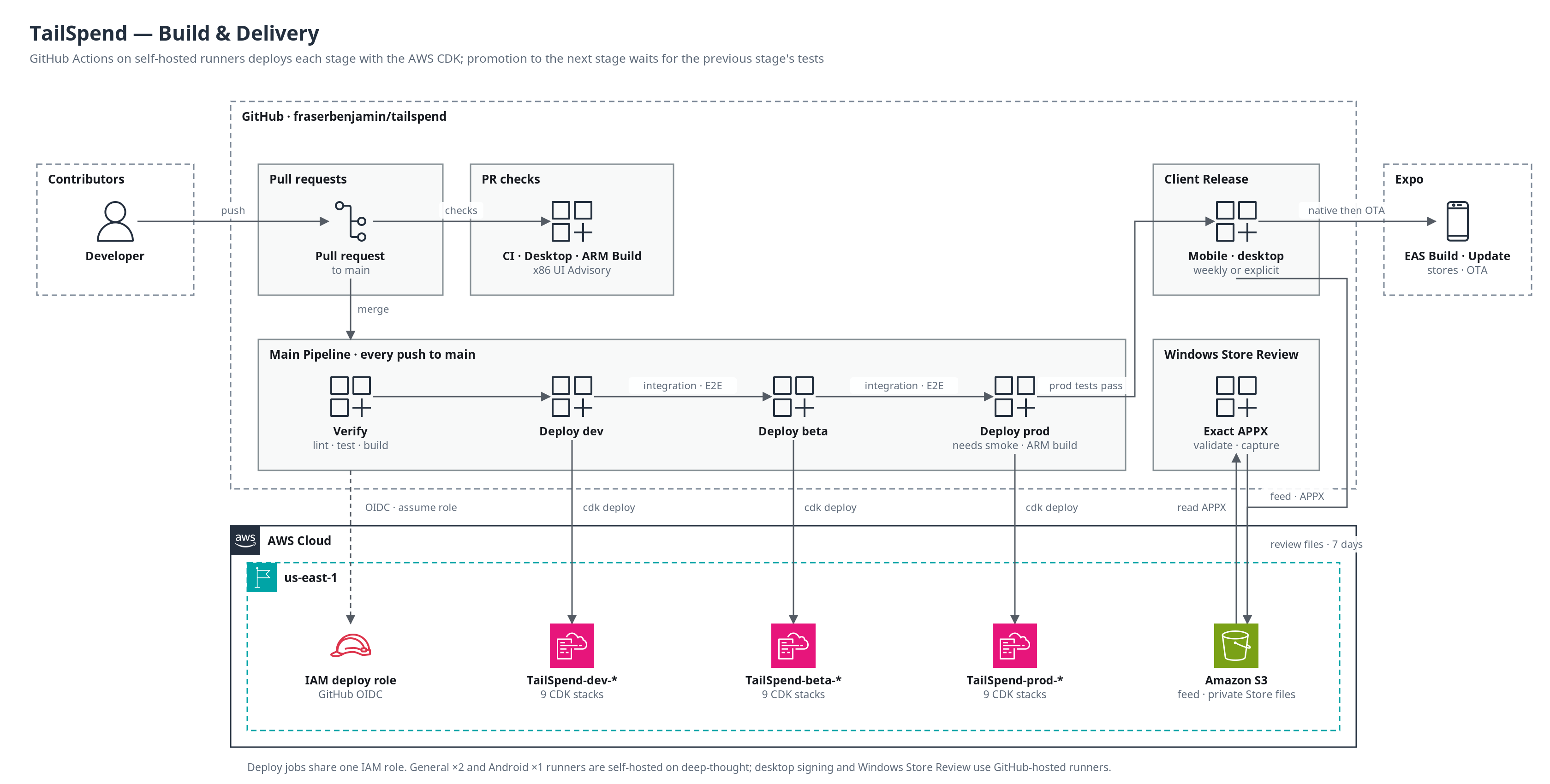
Pull requests run workflows/ci.yml on the self-hosted
general runner pool. PRs also run the desktop smoke test and native UI tests when they
touch the files listed in those workflows' paths: filters. Pushes to main run
workflows/main-pipeline.yml, whose verification,
stage deployments, integration tests, browser tests, desktop smoke test,
ARM native compilation, advisory x86 UI tests, and mobile OTA release use persistent self-hosted runners.
An explicit [client-release] main commit also releases every changed client
from that exact SHA after both production suites pass. Native builds finish
before OTA publication; ordinary commits retain the weekly release schedule.
Both verification jobs run turbo run lint check-types test build and validate workflow YAML.
Runner Pools
Deep-thought has three runner services:
| Runner | Custom Label | Installation | Service Home |
|---|---|---|---|
deep-thought |
android |
/home/fb/actions-runner |
/home/fb |
deep-thought-general-1 |
general |
/home/fb/actions-runner-general-1 |
/home/fb/.runner-homes/general-1 |
deep-thought-general-2 |
general |
/home/fb/actions-runner-general-2 |
/home/fb/.runner-homes/general-2 |
General CI, deployment, browser, desktop, and release jobs use the
general pool. Native Android UI tests require
[self-hosted, Linux, X64, android], reserving that runner for the emulator.
Only the Android runner should have the android label, and it must not have
the general label. Each service needs its own installation and workspace.
All services run as fb. The general services have systemd drop-ins that set
HOME and XDG_CACHE_HOME to their separate persistent directories. This
isolates concurrent tool installation and user-level configuration while
retaining each service's caches. The Android service retains its Android SDK,
Gradle, Maestro, and AVD directories. Its emulator uses port 5556, so a single
Android runner prevents simultaneous native jobs from competing for that port.
The existing workflow dependencies still enforce dev → beta → prod promotion. The main pipeline remains serialized across pushes; independent jobs within a pipeline can now use separate runners.
Caching on self-hosted runners
The runner account's home directory must persist between jobs. npm and Playwright use their existing directories there; their caches are not restored from or uploaded to GitHub on self-hosted jobs.
- npm:
npm ci --prefer-offlineuses the runner's npm download cache (normally~/.npmon Linux), fetching missing packages as needed. It still installs a clean dependency tree from the lockfile for every job.actions/setup-nodehas package-manager caching explicitly disabled on self-hosted jobs, including the automatic caching enabled bypackageManagerin the rootpackage.json. Node itself still uses the runner's tool cache. - Playwright: browser binaries remain in
~/.cache/ms-playwrighton Linux. Every self-hosted E2E job runsplaywright install chromiumto ensure the current package's required browser revision exists. Existing revisions are reused. System dependency installation runs on both warm and cold caches. - Turbo: verification, deployment, and desktop smoke jobs set
TURBO_CACHE_DIRto$HOME/.cache/$GITHUB_REPOSITORY/turbo/$RUNNER_OS-$RUNNER_ARCH/$(node --version). This shares task outputs between jobs and runs on the same host, with separate directories per repository, OS, architecture, and Node version. Keeping the cache outside the checkout letsactions/checkoutcontinue cleaning the workspace without deleting cached task outputs.
No runner provisioning change is needed when the existing home directory persists. A new runner or empty cache warms up automatically. If the runner is containerized, these directories must live on a persistent volume to retain the benefit. Monitor their disk usage; old Turbo version directories can be removed when no jobs are using them, at the cost of rebuilding on the next run.
No job uses GitHub's Actions cache, hosted or self-hosted, because artifacts
and caches share the account's small Actions storage quota (#598, #679). Hosted
desktop builds rely on the Turborepo remote cache instead. Artifact uploads are
failure reports kept for 1–2 days, and dry-run desktop installers for one day. The
Microsoft Store APPX and Windows review screenshots/validation reports go to
the existing private, seven-day S3 submission prefix instead (see
apps/desktop/README.md). npm run lint:workflows fails on an upload without
retention-days of 7 or less, on actions/cache, and on a setup-* cache.
Every Monday, Client Release's Report Actions Storage job lists this
repository's live artifacts and caches in its summary. It warns above 300 MB
(see scripts/actions-storage-report.mjs).
Turborepo Remote Cache
Turbo also uses Vercel's remote cache when TURBO_TOKEN and TURBO_TEAM are
configured. This shares task outputs with hosted PR jobs and developers, while
the persistent self-hosted cache allows reuse directly from disk. There is no
actions/cache archive of .turbo.
Required GitHub configuration
| Name | Type | Where to set | Value |
|---|---|---|---|
TURBO_TOKEN |
secret | Settings → Secrets and variables → Actions → Secrets | API token from https://vercel.com/account/tokens |
TURBO_TEAM |
variable | Settings → Secrets and variables → Actions → Variables | Vercel team slug, or team_<id> for a personal account |
TURBO_REMOTE_CACHE_SIGNATURE_KEY |
secret | Settings → Secrets and variables → Actions → Secrets | Any random string (e.g. openssl rand -hex 32); signs cache uploads |
Without remote cache configuration, Turbo uses its local cache. Self-hosted jobs still share it across runs; a fresh hosted runner has no previous local task cache.
Linking a local checkout
To get the same speedup locally:
npx turbo login          # opens a browser to vercel.com
npx turbo link           # picks the team/project; writes .turbo/config.json
.turbo/ is gitignored, so each contributor runs this once on their machine.
Cache invalidation
Turbo hashes task inputs, declared environment variables, dependency state,
and task configuration to decide which outputs can be reused. Moving its
cache directory does not change those rules; tasks with cache: false,
including OpenAPI/client generation and live tests, still execute normally.
To check the performance change, compare completed run step timings for Node setup, dependency installation, Playwright installation, and Turbo tasks. Self-hosted Node setup should no longer log npm cache downloads, and the Playwright cache action should be skipped. Actual savings depend on cache warmth and changes in dependencies or build inputs.
Native UI tests
workflows/maestro-native.yml requires current-source ARM native compilation with Expo's default Hermes V1 on
[self-hosted, Linux, X64, android]. It builds both armeabi-v7a and arm64-v8a,
then checks the APK has exactly those native ABIs and both React Native and
Hermes libraries for each. Main Pipeline requires this job to succeed.
The same Intel runner also runs the Maestro launch/navigation/permissions and
screenshot flows on an x86_64 emulator as an advisory job for PRs/manual runs.
Main Pipeline skips this unsupported-architecture runtime job. The known
Hermes/GWP-ASan x86 startup issue (#713) must not force an engine downgrade or
block ARM releases. This job can fail while the workflow succeeds; its result
is not ARM device acceptance. Maestro E2E provides a manual entry point.
No ARM runner is registered, so ARM emulator/device UI acceptance is currently
a separate release checklist item; a cross-build cannot execute ARM code.
CI loads the host's KVM module when needed and grants the runner account
read/write access to /dev/kvm using a per-user ACL. This applies immediately
to the running service without restarting it or making the device world-writable.
The setup requires passwordless sudo, installs acl if missing (waiting up to
ten minutes for another package installation to finish), and verifies
access with the Android emulator's -accel-check. The host must expose CPU
virtualization; containerized runners must mount /dev/kvm. SDK tools and
Gradle caches live under ~/.cache and survive checkout cleanup. Maestro stays in ~/.maestro and is only downloaded when the pinned version is missing. CI installs the Android SDK and Java, then creates a disposable
emulator. Reports, screenshots and the build log are uploaded even on failure.
See apps/mobile/e2e/README.md for local Android and iOS commands. The Linux
runner cannot execute Apple's iOS simulator.
Android Build Disk Space
Both Android jobs run scripts/prepare-android-space.mjs before installing
workspace dependencies. A build needs at least 20 GiB free on the checkout's
filesystem. When space is low, the script removes only the repository's generated
Gradle version/transform caches and build-cache-* task outputs.
If that is insufficient, it also removes the repository's sibling turbo/
cache in that Android runner's own home namespace. These task outputs are
regenerable; the next task run rebuilds them. Other repositories' caches and
the separate general-runner home namespaces are outside cleanup's scope.
Downloaded Maven modules, Gradle distributions, the Android SDK, AVDs, settings and credentials
are retained. The script rejects cache symlinks/misconfigured roots and fails
before compilation if cleanup still cannot meet the minimum. The ARM build
remains required; disk pressure never bypasses compilation or ABI verification.
If cleanup is insufficient, the job log includes filesystem capacity and sizes
of the current runner's repository caches, default Gradle cache, Android SDK,
AVDs, npm cache and checkout. This read-only report works even when GitHub's
artifact quota is full. API startup measurement collection and artifact uploads
are also advisory; integration test failures still block stage promotion.
An explicit native recovery option (local_android: true, or the main merge
markers [client-release] [local-android]) also uses this Android runner to build
and sign a production AAB with EAS locally. It verifies the bundle, signature
and ARM libraries before waiting for Google Play submission; iOS builds on EAS
cloud independently. Both builds still gate OTA and native release tagging. See
mobile release recovery.
Beta Native Build Acceptance
The manual EAS Build workflow accepts preview-simulator for beta Android
APK and iOS simulator builds with the preview channel. Expo Doctor runs before
cloud builds; the workflow waits for both requested platforms and checks the
returned build status. See the mobile release guide
for archive inspection and the separate device acceptance gate.
The live API integration suite now verifies expense create/edit/mention/delete history through the deployed stream worker, actor exclusion, muted-history retention, and removal of device registrations/token claims on account deletion. It uses disposable accounts and groups. Those tests do not prove device display or notification-tap navigation.
Integration Fixture Recovery
The deployed integration suite retries only DNS/connect failures known to occur
before a request is sent, with at most three attempts. Established-socket
failures, read/header timeouts and HTTP errors remain visible; ambiguous writes
are never replayed by this helper. App fixture requests separately retain their
existing single retry after an explicit HTTP 429. Developer requests expose 429
responses directly so allowance assertions remain meaningful. Helper safety
checks run without AWS under npm test --workspace api-integration-tests.
The developer role-revocation test creates a fresh group per attempt. A test retry cannot inherit an already-approved member or demoted role and obscure the original failure with an unrelated join-request conflict. Production integration and route-coverage gates remain mandatory.